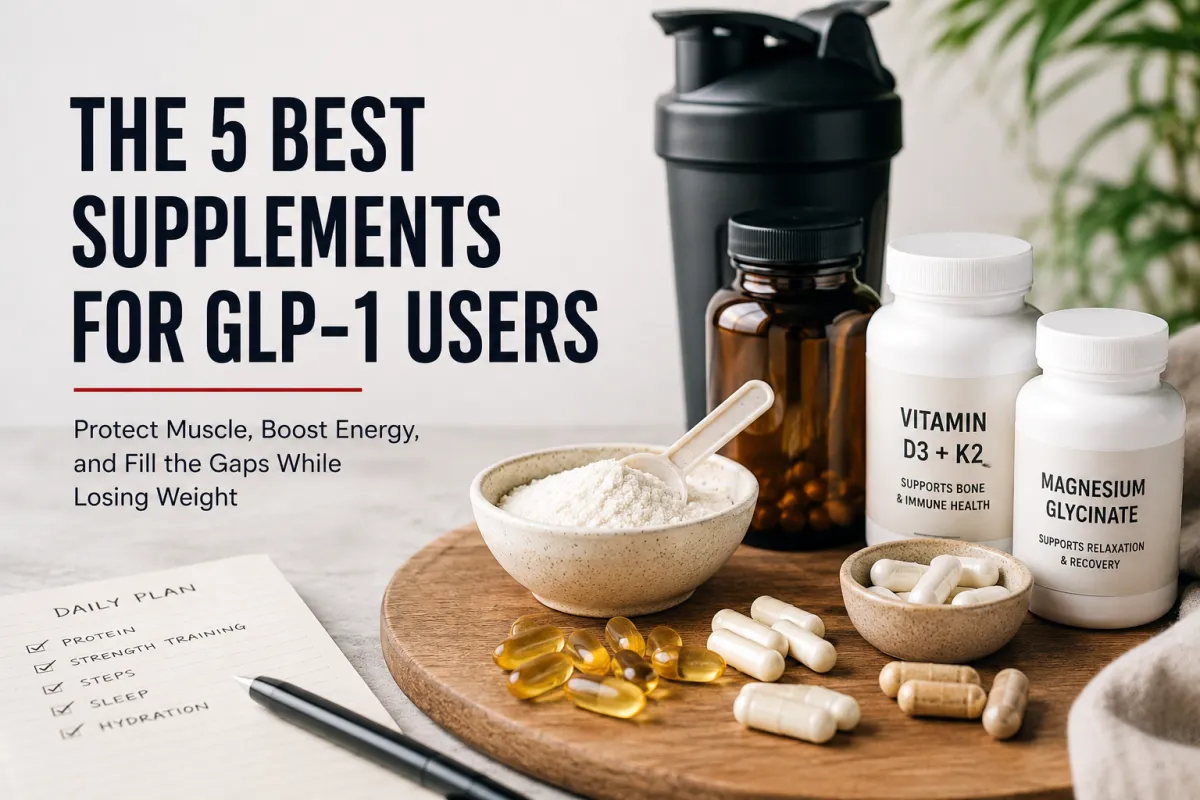
The 5 Best Supplements for GLP-1 Users (Backed by Research)
The 5 Best Supplements for GLP-1 Users (Backed by Research)
You're eating less. The scale is moving. Your doctor is thrilled.
But somewhere around week six, something starts feeling off. Fatigue that doesn't match your progress. Weakness you didn't expect. A flatness that no one warned you about.
Most people chalk it up to "the medication adjusting." A few google it and end up down a Reddit rabbit hole. Almost nobody gets a straight answer.
Here's what's actually happening: GLP-1 medications work by suppressing your appetite enough to create a caloric deficit. That's the mechanism. But when you're in a deep deficit without the right support, your body doesn't just burn fat — it burns muscle too. And the less you eat, the less micronutrients you get, which creates a cascade of deficiencies most GLP-1 users don't even know they have.
The right supplements won't replace a real protocol. But for GLP-1 users specifically, they fill critical gaps that food alone isn't covering anymore.
Here are the five that actually matter — and why the research backs them up.
1. Creatine — The Most Important One Most People Skip
If you're on GLP-1 and only take one supplement, make it this one.
Creatine is the most studied performance supplement in the world, which means there's essentially zero debate about whether it works. What most people don't know is that its benefits go way beyond lifting heavier weights.
During a caloric deficit — which is exactly where GLP-1 puts you — your body is in a catabolic state. It's breaking things down. Muscle included. Creatine helps counteract this by increasing the availability of phosphocreatine in your muscles, which helps them produce energy more efficiently and recover faster.
A 2021 review published in Nutrients found that creatine supplementation significantly preserved lean mass during caloric restriction compared to placebo. Another study showed that older adults supplementing with creatine during a resistance training program lost significantly less muscle than those who didn't.
This matters on GLP-1 because your appetite is suppressed — which means your protein intake is lower, your energy is lower, and your training intensity is often lower. Creatine gives your muscles a buffer. It's not magic, but at 3-5 grams a day, it's one of the best-studied interventions for maintaining muscle during exactly the conditions GLP-1 creates.
The dose: 3-5g per day. No loading phase needed. Take it consistently and it works.
One thing to know: Creatine causes your muscles to hold a small amount of water. The scale might tick up slightly in the first week. That is not fat. Do not panic.
2. Fish Oil (Omega-3s) — Protecting Muscle You Can't See on the Scale
Here's something that doesn't get talked about enough: omega-3 fatty acids directly influence muscle protein synthesis.
Most people think of fish oil as a heart health supplement. And yes, it's good for that. But for GLP-1 users specifically, the research on muscle preservation is what makes it worth taking.
A 2011 study published in Clinical Science found that omega-3 supplementation stimulated muscle protein synthesis in healthy adults — even without exercise. A follow-up study showed similar effects in older adults, a population that overlaps heavily with GLP-1 users.
The mechanism is anti-inflammatory. Rapid weight loss — especially the kind GLP-1 creates — increases systemic inflammation. Omega-3s (specifically EPA and DHA, the active components) reduce that inflammatory response, which creates a better environment for muscle preservation.
There's also an appetite angle. GLP-1 already suppresses hunger. Fish oil helps with the quality of the calories you are eating by improving how your body uses fat for fuel and supporting mitochondrial function. That matters when you're running on a reduced caloric intake and wondering why your energy is still low.
The dose: 2-4g of combined EPA + DHA daily. Look at the back of the label — you want the total EPA + DHA number, not just "fish oil." A 1,000mg fish oil capsule might only have 300mg of actual EPA/DHA.
Brand note: Get one that's been third-party tested. Fish oil quality varies massively.
3. Vitamin D3 + K2 — The Deficiency Almost Every GLP-1 User Has
Vitamin D deficiency is already widespread — somewhere around 40% of Americans are deficient. But GLP-1 users have an additional problem: they're eating less food, which means less dietary vitamin D, less sun exposure from a more sedentary lifestyle during early medication stages, and often less absorption of fat-soluble vitamins due to the rapid changes in eating patterns.
Why does this matter for muscle? Because vitamin D receptors exist in muscle tissue. Deficiency is directly associated with muscle weakness, reduced force production, and increased risk of falls — especially in older adults.
A 2013 meta-analysis in the Journal of Clinical Endocrinology & Metabolism found that vitamin D supplementation significantly improved muscle strength in deficient individuals. Not a minor improvement — a meaningful, measurable difference.
K2 pairs with D3 because vitamin D increases calcium absorption, and K2 makes sure that calcium goes where it should (bones and teeth) rather than where it shouldn't (arteries and soft tissue). If you're taking D3 without K2, you're leaving half the equation incomplete.
The dose: 2,000-5,000 IU of D3 daily, plus 100-200mcg of K2 (look for MK-7, the most bioavailable form). Get your levels tested if you can — your doctor can run a simple blood panel.
Real talk: This is one of the most underrated supplements on this list. The fatigue and weakness that GLP-1 users often attribute to the medication is sometimes just vitamin D deficiency that was already there getting worse.
4. Electrolytes — The One Nobody Mentions Until You're Cramping
When you eat less food, you consume less sodium, potassium, and magnesium. When you lose weight rapidly — especially water weight in the first few weeks of GLP-1 — your body excretes electrolytes faster than you're replacing them.
The result? Fatigue. Headaches. Muscle cramps. Brain fog. A general sense of feeling terrible that most people blame on the medication.
Some of it is the medication. A lot of it is electrolytes.
This isn't controversial science — it's basic physiology. Electrolytes regulate muscle contraction, nerve signaling, fluid balance, and energy production. When they're depleted, everything slows down. When they're replenished, people often notice improvement within 24-48 hours.
The reason this doesn't get talked about more is that there's no single study on "GLP-1 users and electrolytes" because it's so foundational it doesn't need one. The research on electrolyte depletion during caloric restriction and rapid weight loss is decades old and well-established.
What to take: A sugar-free electrolyte supplement that includes sodium, potassium, and magnesium. Products like LMNT or similar are popular because they actually have therapeutic amounts of each — not the trace amounts in most sports drinks.
Timing: Morning is best for most people. If you're doing resistance training, also take some around your workout.
Most people don't realize how much of what they're feeling on GLP-1 is fixable. That's exactly why we built the free GLP-1 Muscle Risk Calculator — to help you understand what's actually happening in your body based on your specific dose and timeline. You can check your personal muscle risk score free at rededgecoaching.com.
5. Magnesium Glycinate Before Bed — Sleep, Recovery, and Everything Else
Magnesium is involved in over 300 enzymatic reactions in the human body. It regulates muscle and nerve function, blood sugar, protein synthesis, and sleep quality. Most Americans are already deficient before GLP-1. Add significantly reduced food intake and you've got a deficiency that compounds quickly.
The glycinate form specifically is worth noting. Magnesium comes in many forms — oxide, citrate, malate, glycinate — and they're not all equal. Glycinate is chelated to the amino acid glycine, which makes it more bioavailable and significantly gentler on your stomach. This matters because GLP-1 users already have a sensitive GI system. Magnesium oxide (the cheap form in most supplements) causes digestive distress in a lot of people. Glycinate almost never does.
A 2012 study in the Journal of Research in Medical Sciences found that magnesium supplementation significantly improved sleep quality in adults. Another study showed magnesium supplementation reduced cortisol levels — relevant for GLP-1 users because elevated cortisol promotes muscle breakdown and fat retention, especially in the midsection.
Sleep quality on GLP-1 can be disrupted, particularly around injection days. Recovery happens during sleep. Muscle preservation happens during sleep. If your sleep is poor, the rest of your protocol — training, protein, everything — is working at a fraction of its capacity.
The dose: 200-400mg of magnesium glycinate 30-60 minutes before bed. Start at 200mg and increase if needed.
The experience: Most people report noticeably deeper sleep within the first week. Some notice they wake up less. A few notice they're less anxious. All of that is the magnesium, and all of it supports better recovery.
The Bottom Line
These five supplements aren't going to compensate for a bad protocol. They won't replace protein. They won't replace resistance training. They won't do the work that GLP-1 physiology requires.
But they fill the gaps that eating significantly less food creates. And for most GLP-1 users — gaps that nobody bothered to explain before now.
To summarize:
Creatine — preserves lean mass during caloric restriction. 3-5g daily.
Fish Oil — supports muscle protein synthesis and reduces inflammatory muscle loss. 2-4g EPA/DHA daily.
Vitamin D3 + K2 — corrects the deficiency most GLP-1 users already have. 2,000-5,000 IU D3 + 100-200mcg K2 daily.
Electrolytes — replaces what reduced food intake and rapid weight loss deplete. Daily, especially around training.
Magnesium Glycinate — improves sleep quality, reduces cortisol, supports recovery. 200-400mg before bed.
Stack these with a resistance training protocol designed for GLP-1 physiology and the right protein targets for a suppressed appetite, and you're doing something most GLP-1 users never get the chance to do — actually protecting the muscle while the weight comes off.
You can check where you currently stand with your free GLP-1 Muscle Risk Calculator at rededgecoaching.com. It takes 60 seconds and shows you your personal muscle loss projection based on your specific dose and timeline.
FAQ
Do I need to take all five supplements on GLP-1? No. If you had to prioritize, start with creatine and electrolytes — they have the most immediate impact on muscle preservation and daily energy. Add the others as your budget allows.
Can I take creatine while on Ozempic or Wegovy? Yes. There's no interaction between creatine and GLP-1 medications. Creatine is one of the most studied supplements in existence and has an excellent safety record.
Why do I need electrolytes on GLP-1? Because you're eating significantly less food, which means less dietary sodium, potassium, and magnesium. Rapid weight loss also increases electrolyte excretion. The fatigue and muscle cramps many GLP-1 users experience are often partially (or fully) electrolyte depletion.
What's the difference between magnesium glycinate and regular magnesium? The glycinate form is bound to the amino acid glycine, making it more bioavailable and much gentler on the stomach. Other forms — especially oxide — are cheaper but can cause digestive issues, which is the last thing you want on GLP-1.
Should I take vitamin D if I spend time outdoors? Get your levels tested to know for sure. Sun exposure helps, but most people — even those who spend time outside — don't synthesize enough D3 to maintain optimal levels, especially in northern climates or winter months. Given how important D3 is for muscle function, it's worth knowing your number.
Will fish oil affect the GLP-1 medication? No known interactions. Fish oil is a food-derived supplement and doesn't interfere with the mechanism of GLP-1 medications.
How long before I notice a difference from these supplements? Electrolytes and magnesium glycinate: within a few days to a week for most people. Creatine: 2-4 weeks for full saturation. Vitamin D: 4-8 weeks to meaningfully raise blood levels. Fish oil: 4-8 weeks for anti-inflammatory effects to build.
